Thursday, July 11, 2013

Newark Neon

S. Klein and Howard's Men's Clothes disappeared from Manhattan decades ago, taking their big signs with them.  But over in Newark, their neon corollaries survive, though probably not for long.  Downtown Newark is a preserve for the kind of commercial archeology that is all but gone from Manhattan.  Besides the neon relics of S. Klein and Howard's, Newark retains a good share of other vestigial neon, along with some pretty great hand painted and terrazzo signs, too.  This past March, I joined up with my veteran conspirator Rob Yasinsac to pay homage to Newark's downtown neon, and to see what else we could find.


S.Klein "On The Square" / Broad St. between Cedar and West Park (T. Rinaldi)

S. Klein "On The Square" is often remembered as an institution of Union Square in Manhattan.  Turns out, it was also an institution Broad Street in downtown Newark.  The massive neon sign covering six stories of its main facade is a close cousin of one that once advertised the department store's Union Square location.  Both seem to have been installed around 1950.  An older sign on the rear facade appears to be a re-lettered relic from the building's previous occupant, Hearn's.  Sadly, word is that both signs and the historic buildings behind them are due to be razed imminently.


S. Klein's bygone Union Square Signage. (Carl Burton)


Rear facade, on Halsey St.   (T. Rinaldi)

Just up the street from S. Klein stands the husk of Hahne & Co., one of Newark's flagship department stores.  The signs aren’t neon but still quite an eyeful.


Hahne & Co. Broad, New and Halsey; Halsey St. side. "The Store With The Friendly Spirit" (T. Rinaldi)

Also not neon but still of interest: Kislak, on Broad St. and Central Ave., apparently a relic from the Kislak Realty Co.


Kislak / Broad St. and Central Ave.  (T. Rinaldi)

The Little Theatre boasts the only functioning bit of old neon we found on our tour.  A cute "little" theater indeed, the films screened within rather less so: like many of its now-vanished cousins in New York (the Variety Theatre et-al), the Little Theatre is hangin' in there as a porno venue.


The Little Theatre / 562 Broad St. 

Back near the main crossroads of Broad and Market, the Newark Paramount still has one of the finer neon and incandescent theater marquees anywhere in the tristate, though the theater itself has been shuttered for decades.  The old lobby is now a discount store, but the auditorium behind it is empty.


Newark Paramount Theatre / 195 Market Street

Lording over the intersection of Broad and Market, this remarkable billboard still advertises a long-gone establishment called, appropriately, the Broad & Market Tavern.

The Broadway & Market Tavern, "In the hub of Newark, serving you the best." (T. Rinaldi)

Just around the corner looms the neon herald of Weber and Heilbroner, merchants of "Stein-Bloch Clothes."  Like S. Klein, Weber and Heilbroner had a larger store in Manhattan, on Herald Square.


Weber and Heilbroner Stein-Bloch Clothes / Broad Street (T. Rinaldi)  

Proceeding back onto Market Street, we find:


Miscellaneous painted signs on Market St. between Broad and Mulberry. (T. Rinaldi)

Some very cool old hand-painted window signs, still looking down onto Market Street from vacant offices overhead.  Though most Market Street storefronts are alive and well with bustling if rather honkytonk discount stores, the spaces above seem to be vastly underutilized. 

Meanwhile, underfoot: 


Jack's / Market Street (T. Rinaldi)

Hardy / Market Street (T. Rinaldi)


Abelson's, now Rich Pawns / 825 Broad St. (T. Rinaldi)


Woolworth (now Conaway) / 165 Market St. (T. Rinaldi)

. . . the names of long-vanished Market Street retailers are recalled by a nice collection of handsome old Terrazzo threshold signage.  There's Woolworth's, Jack's, Hardy's, Abelson's, and, is that . . . 


Thom McAn / Broad St. near Market

Yep!

After S. Klein, our next-most exciting find was this four-story high neon remnant of Howard Men's Clothing, at the corner of Market and Halsey.


Howard / Broad and Halsey (T. Rinaldi)


Times Square at New Year's 1956.  Howard signs (in the distance, to both sides of the Admiral TV sign) loomed over the north end of the square for decades.  (Life) 

A pair of very similar signs presided over the north end of Times Square for about forty years.   Howard seems to have been pretty well known in its day, with locations on Long Island and in Allentown, PA, in addition to Newark and Times Square.  They're gone now, and quite forgotten, too, at least as far as the internet is concerned.  But there's still the Howard Building, in downtown Brooklyn, presumably the company's former warehouse, now part of the CUNY campus, which still displays the company's distinctive lettering over its main entrance.  


Bamberger's / 131 Market Street (T. Rinaldi)


Heading up Market Street, we find this rather forlorn ghost clock hanging from the magnificent façade of the former Bamberger's department store, probably Newark's preeminent commercial institution in its day.

Sports/Radio/Kodaks/Frigidaire / Market Street near Washington

Across Market Street from Bamberger's, four old neon signs advertise such wares as "Kodaks," Sports," "Radios," and "Frigidaire" for a vanished downtown retailer.  Does anyone reading this know what store these belonged to? 


Bushberg Bros. / 77 Market St. (T. Rinaldi)

Bushberg Bros., a recently departed furniture store, left this sign in place after it decamped from its Market Street digs a few years back. Older signage up above recalls the building's previous occupant, Kirch's furniture - one of a nice handful of ancient painted signs still to be found up and down Market Street.


Mystery sign / Washington St. off Market (T. Rinaldi)

Rounding the corner onto Washington Street, we find this curious neon ghost.  Does anyone out there know what this once advertised?

Further down Washington, this quaint storefront is home to Miller’s Cafe, which would seem to have all the makings of a time-honored, mom-n-pop lunch spot.  


Miller's Cafe / 270 Washington St.

Oops! Turns out it's a strip club.  Oh well, that's still some delightful hand-painted lettering…

Miller's Cafe (T. Rinaldi)

Winding back down Branford Place, the old school mom-n-pop eatery manifests itself, in the form of the venerable Hobby's Deli.  I regret to say we didn't stop in, having already sated ourselves at the Dinosaur Bar-B-Que over on Market Street by the time we found it.  There's always next time . . .


Hobby's / 32 Branford Place (T. Rinaldi)

Tuesday, July 2, 2013

Hinsch's Luncheonette

I'll go light on the text, partly because the photos can speak for themselves, and partly to heed my grandmother's advice that one with nothing nice to say might better say nothing at all. 

Say it ain't so, Hinsch's!  Amid its latest ownership change, this ancient but lately troubled Brooklyn luncheonette has ditched its spectacular, 65-year old neon projecting sign, according to photographic evidence circulating on Facebook.  A new sign in the shape of the old one has gone up in its place. (Hinsch's old script fascia sign is still there, but looking in need of a little help.)  Why anyone would forgo the incredible stand-out value of such a unique classic is beyond me.  


Hinsch's, before and after.  (T. Rinaldi, top; John Shea/BAY RIDGE/Kevin Walsh on Facebook, below)

The backstory: in late 2011, Hincsh's longtime ownership announced that it was calling it quits after more than six decades at its Bay Ridge location.  As eulogies poured in from all over town, word came that new owners had stepped in and given the restaurant a last minute reprieve.  But things didn't go as planned:  after about a year, the new management reported financial troubles, and reluctantly announced that they, too, would close up shop.  Then, just when all seemed lost, word came that yet another owner had stepped up to try to keep the old business afloat.


RIP: Hinsch's old sign featured deco details and pin-striping set in porcelain enameled steel, with exposed tube neon in two colors. (T. Rinaldi)

This latest turn of events has apparently brought about the demise of what was without a doubt one of the best old signs in New York.  Other changes are evident, too: the new sign suggests a name change ("Mike's Hinsch's"?), broadcasts the establishment as a "diner," and announces a new, 24-hour schedule.


(T. Rinaldi)

Nice to see new lifeblood pumped into an old neighborhood institution.  Not nice to see it done at the expense of what made this place so appealing in the first place, what made it stand out as something different.  In writing recently on the restoration of Circo's Pastry Shop's sign over in Bushwick, I opined that "inasmuch as a sign's job is to draw attention, nothing does the job like an old neon storefront today."  With every old sign down, the ones that remain stand out that much more.


UPCOMING NYNEON TALKS:
• July 22, 2013, at the NYPL / Mid-Manhattan Branch.


Thursday, June 27, 2013

Stonewall Neon, Then and Now

One of my favorite signs that I never saw was the big neon hulk that formerly hung over the Stonewall Inn at 58 Christopher Street in Greenwich Village.  It appears in the backdrop of photos showing the Stonewall Uprising, which took place 44 years ago today (June 28, 2013).

  
The sign is gone now.  But I was reminded yesterday that Stonewall still has some neon, and a respectable sign at that.

 (T. Rinaldi)


Congratulations to Edie Windsor and hats off to what is likely to be the most photographed neon in town this weekend.  

(Diana Davies / NYPL)

(T. Rinaldi)

Thursday, June 20, 2013

St. Regis Cab Call


Not quite neon, but still of interest, I hope.

So I'm walking down East 55th Street, just minding my own business, when an odd bit of commercial archeology caught my eye. Fifth Avenue in midtown is just about the last place on earth one might expect to run across such a relic, but there hanging over the awning of the super-swish St. Regis Hotel was something I'd never seen before.

 
St. Regis Cab Call. (T. Rinaldi)

Thankfully, the lettering on the sign offers a clue to its raison d'etre:  "ST. REGIS CAB CALL," it says.  Otherwise, frankly, I wouldn’t know what the hell to make of it. The three incandescent digital panels below, it would seem, could be set to indicate any number up to nine-hundred ninety-nine. 

Not long after spotting this, I began to notice other signs like it in old photographs of the New York City streets.  Apparently, cab call signs were once fairly common, found at places like the old Metropolitan Opera on Broadway, or the Plaza Hotel – basically, anywhere you'd expect to find cabs lined up. 

 
Met Opera Cab Call, c. 1905.  (Shorpy / Detroit Publishing Co. / Lib. of Congress)

Today the cab call signs seem all to have vanished, with this one exception.  Sort of remarkably, the St. Regis keeps the sign in working condition: the numbers are set to read zero-zero-zero now, making this perhaps the very last authentic, functional, exposed bulb sign of its type in the city. 

 
Plaza Hotel Cab Call, 1912. (Shorpy / Detroit Publishing Co. / Lib. of Congress)

The mystery, though, is this: so how did it work?  Were the numbers supposed to indicate how many fares were lined up under the awning?  Would this really require a three-digit number?  Or was there some other secret code going on? 

 
Saks Fifth Ave Cab Call. (MCNY)


Liberty Theatre Cab Call. (Buena Vista University)

Alas, no one at the St. Regis seems to know, so the secret of the St. Regis Cab Call remains the domain of Midtown past.

IN OTHER NEON NEWS: 
• Riverside Liquors on the Upper West Side is moving - and they're taking their sign with them.
• Mystery neon brought to you by the MCNY.
• Check out Kirsten Hively's neon photos at Cafe Grumpy in Greenpoint, Brooklyn.

UPCOMING NYNEON TALKS:
• July 22, 2013, at the NYPL / Mid-Manhattan Branch.

Thursday, June 13, 2013

Circo's Pastry Shop

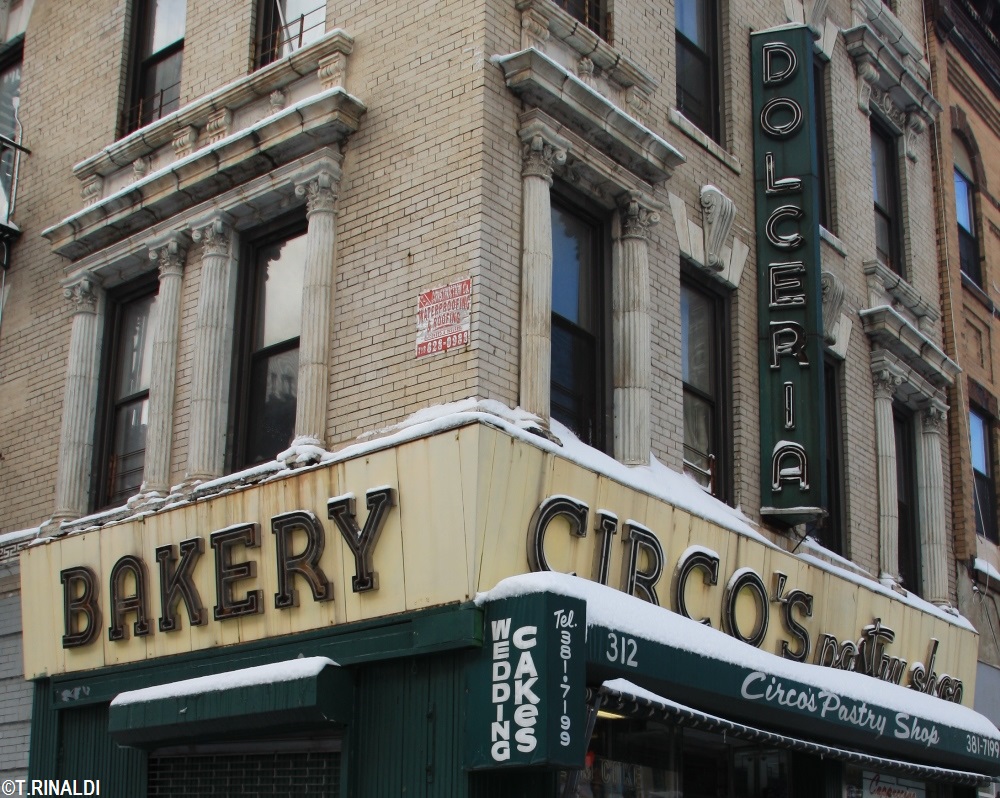
There was something particularly vexing about the sight of Circo's handsome old signs un-lit.  I had really, really hoped to include this venerable Bushwick pasticerria in the neon book. In the end I had to make do with daytime shots of darkened, snow-covered signs.

Circo's Pastry Shop, at 312 Knickerbocker Ave. in Bushwick, Brooklyn, pre-restoration.  (T. Rinaldi) 

Then, not long ago, I heard from Robbie Ingui of Artistic Neon that the fine folks at Circo's had hired him to bring the signs back to life. In terms of restoration, I often liken old neon signs to old cars. Sometimes, a little spit and polish is all you need.  Other times, a sign has reached a point where it needs to be restored from the ground-up.

Nice work if you can get it: making patterns for replacement tubes. Robbie Ingui assited by Greg Lowe. (T. Rinaldi)

At Circo's, Robbie found the signs in fairly decent shape. Their 60-year old enameled sheet metal had been painted over, stainless steel channel letters lost their sheen, and the framework holding it all together had corroded somewhat over the years. But Robbie was able to get the signs re-lit without a full removal and reassembly, thanks partly to a crawlspace over the shop's ceiling that provided access to components in back.

Robbie and Greg using plexiglas to trace the original channel letters.  (T. Rinaldi) 

The neon tubes on the other hand hadn't fared so well. After 60 years, electrodes had failed, fluorescent coatings worn out, sockets had grown brittle and some tubes were cracked and broken. Rather than saw-off and replace each failed electrode and then re-pump gas into the tubes, Robbie fabricated a complete new set of glass letters to match the originals.

New tubes were bent to match patterns made from the originals. (T. Rinaldi) 

Neon tube benders today employ the same basic materials and techniques that prevailed when Circo's first installed these signs sixty years ago.  The replacement tubes match their predecessors not just in size and color, but in almost every detail of their fabrication.  Even by the standards of architectural restoration, where fiberglass sometimes substitutes for terracotta, this is in-kind replacement to the utmost extreme.

Cork separators and copper wire keep the tubes in position, just as they did on the originals. (T. Rinaldi) 

Back in the shop, Robbie demonstrates tracing, bending and splicing the new tubes. (T. Rinaldi)

Old neon signs and good Italian pastries seem to go hand in hand. To wit: Veniero's and DeRobertis on Manhattan's East Side, D'Aiuto's on the West Side, Egidio's up in the Bronx, Rispoli's in Bensonhurst (my family's old go-to, now gone), and of course Circo's. In my experience, Italian pastries just don't taste as good if they haven't come out of an old, neon-crowned storefront.

Of stainless steel and sfogliatelle: Circo's exudes authenticity in every detail. (T. Rinaldi) 

Circo's has all the accoutrements of those classic, family-owned pasty shops that vouch for the authenticity of the goods within.  From its gleaming stainless steel window frames to its terrazzo floor to the neon over the storefront, it's all there and in great clip, too.  In their book Store Front, photographers James and Karla Murray tell us that Circo's has been up and running at its current location since 1945. The business originally opened at another storefront down the block two years earlier.  In 1970, old Mr. Circo sold the business to Nino Pierdipino, whose sons Salvatore and Anthony run the business today.  DOB records date the signs to 1953, making them 60 years old in 2013. 

Robbie fits electrodes and fires up one of the replacement tubes. (T. Rinaldi) 

Recently, when the Pierdipinos decided to do some sprucing up, they actually considered scrapping the neon and going LED.  Happily, they decided to repair the signs instead, starting with the horizontal fascia signs (the vertical DOLCERIA sign may come later).  Artistic Neon, the shop Circo's contracted to do the job, is located just across the Brooklyn-Queens border in Ridgewood.  Like Circo's, Artistic Neon is a multi-generational, family-owned, Italian-American business, having got its start 40 years ago by Gasper Ingui.  Gasper began as a tube bender in the early 1950s.  Later, he passed his skills along to Robbie, his son, who runs the business today.

Robbie will also refurbish Circo's window signs. (T. Rinaldi) 

Last week, having cleaned up the sheet metal and re-painted the metal backings within the channel letters, Robbie set about installing the new glass letters with the help of Greg Lowe, who he had enlisted to assist with the Circo repairs.  The job took most of the day.  Then, a little before 4pm, Circo's came unceremoniously back to light.  The sign glows now as well as it ever did, but it still bears some of that patina that befits a fine old storefront like this.  Inasmuch as a sign's job is to draw attention, nothing does the job like an old neon storefront today.  Circo's old sign isn't just the brightest thing on the block: it marks this as a business that has stood the test of time.  There is nothing like it anywhere on this stretch of Knickerbocker Avenue today.  Maybe it's just me, but I swear I can taste the difference.


Back in business: Circo's neon turning heads just hours after installation.  (T. Rinaldi)

MANY THANKS to Sal Pierdipino, Robbie Ingui, Greg Lowe and Ellen Barton for their help and moral support.

IN OTHER NEON NEWS: 
• As forecast, Macy's old reverse-channel beauties at 34th and Seventh are gone, as is Tad's Steaks c. 1960 signage across the street.
• Last chance to pick up some old Williamsburg shoe store neon!  Contact me for details.  
• Some very, very stimulating historic photos of So-Cal neon in its prime, via Gizmodo and the Southern California Edison Archive.  (Scroll down - thanks to Emilie Evans for this link.)
• Ghost signage (not neon) on 14th Street, the via Ephemeral NY blog.
• A photographic tribute to some Albany (NY) neon, at the former Olympic Bar and Restaurant, by way of Chuck Miller, the Albany Times-Union, and the Society for Commercial Archeology.
• Enjoy the neon paintings of Kathryn Siegler (Thanks to Paul Shaw for the link).  

UPCOMING NYNEON TALKS:

• June 19, 2013, for the Lower East Side Preservation Initiative at the Neighborhood Preservation Center.
• July 22, 2013, at the NYPL / Mid-Manhattan Branch.